Stage Monitoring with Hearing Loss: Part 2
This article provides practical guidance for performers with hearing loss, as well as supporting knowledgeable audio engineers who are mixing monitors for an artist with hearing loss. For further discussion on the topic, please listen to the Talking Ears episode.
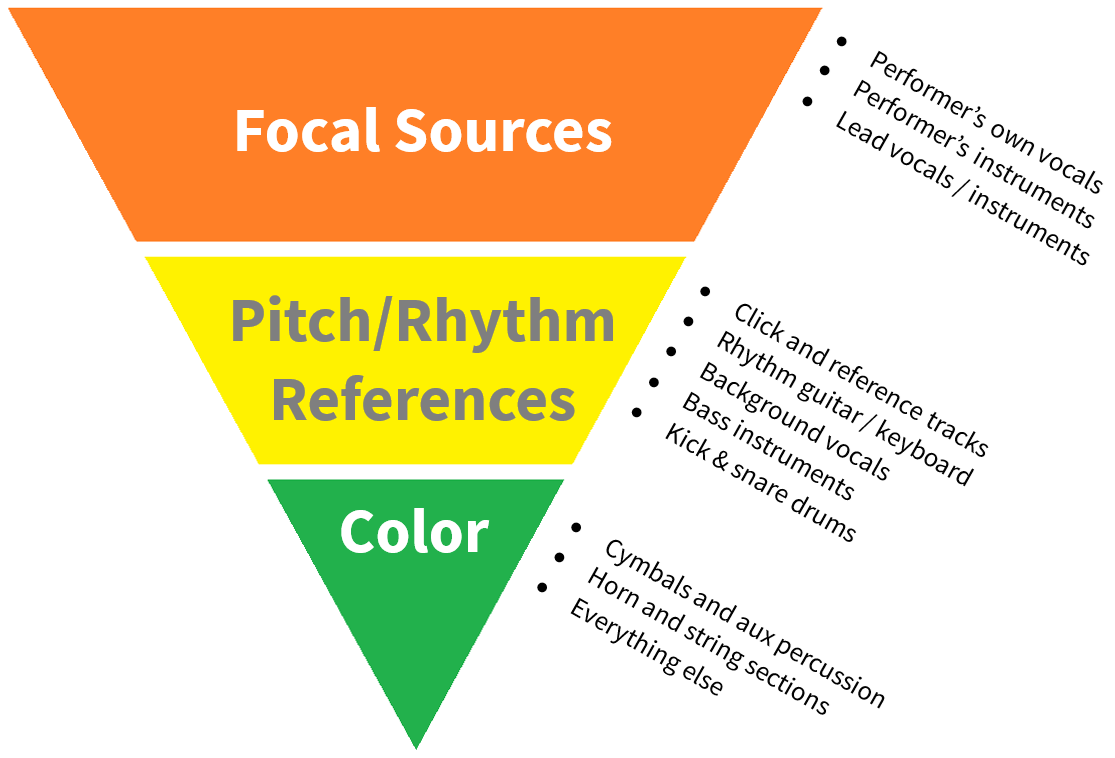
This is the second of a two part article series. We will pick up right where we left off, so if you missed Part 1 you can view/listen here. This section hinges on concepts such as focal sources and mix simplification, which are covered extensively in part 1.
Managing Frequency Space
When mixing stage monitors for performers with hearing loss, several strategies can improve clarity:
High-pass non-critical sources to preserve low-frequency space for kick and bass. This avoids undue interference from the upwards spread of masking when there is too much energy reserved for the low frequencies of instruments and sources that don’t need to have that bass and sub-bass energy.
Reserve low-mid space for focal sources such as vocals, guitar, or keyboards. One can be more liberal with high-pass (low-cut) filters when mixing for an audience of one, so pulling out energy in the 100 - 400 Hz range from non-focal sources will make space for the focal sources to cut through and maintain their pitch clarity.
Manage high-frequency airspace so focal sources remain clear. Same concept as the low-mid space, but using low-pass (high-cut) filters on non-focal sources. This is especially important when working with a high-frequency hearing loss, as competing signals may overwhelm the performer in frequency ranges where the hearing loss is most severe.
Spatial Processing
Panning can be powerful in untangling complicated mixes, but it must be used with awareness of asymmetries in the audiogram. For instance, panning an important pitch reference instrument (bass, keyboards, rhythm guitar, etc) to the ear with more hearing loss can result in a poor listening experience.
If the performer has limited hearing in one ear, they can experience a lack of dimensionality and separation when signals are piled on top of each other. One tried-and-true solution to create dimension is the careful use of short reverbs and delays. These can help perceptually push elements back in the mix, and are best used on non-focal sources.
However, caution should be used when considering aesthetically pleasing long reverb or delays. While these may give a lush listening experience to the audience, the extended tails can muddy the signal for the performer. Hearing loss and recruitment may also limit the audibility of these spatial effects, so they should be used sparingly and with intent to separate, not just to pretty-up the mix.
Output Processing
After simplifying the mix and prioritizing the focal sources, we can get into the business of audiogram-informed processing. These are staring steps, but it is important to consider this a non-linear path with adjustments to all steps being interconnected.
Apply EQ based on the audiogram. A good starting place is the third-gain approach (discussed in part 1), and increasing toward half-gain as needed. When the performer is wearing in-ear monitors, it is important to note any asymmetries and apply different processing to the left and right channels. This can typically be done within a single modern EQ plug-in or outboard EQ unit, but would be difficult to achieve using a simpler analog mixing board master EQ section.
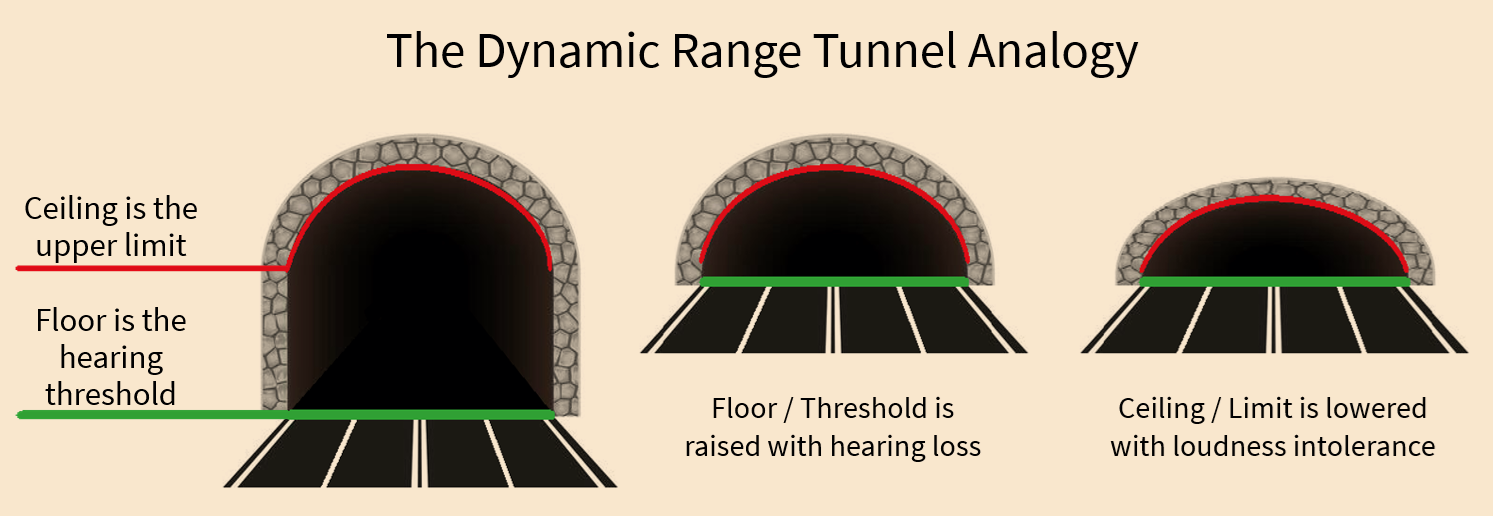
Use multiband compression where significant gain is applied. This is a good place to bring back the tunnel analogy for dynamic range, and respect that folks with hearing loss have reduced hearing real estate available. Experiment with a longer attack and slower release to add clarity and avoid competition of sources. Remember that everyone’s hearing - and hearing loss for that matter - is different, and these settings will need to be explored to optimize the listening experience.
Finish with a peak limiter or multiband limiter to control transients and protect hearing. As with any peak limiting, be careful to avoid aggressive gain reduction as this can negatively impact clarity.
If the results are still unclear, it is advised to reconsider the mix elements and further simplify the sources being presented to the performer.
Because the engineer may hear differently than the performer, trust and communication are essential during this process. It is a rare occurrence that the first settings are the final settings.
Hardware Solutions
There are several purpose-built systems which can aid in this process. Disclosure: while we work with these manufacturers and use their systems, we do not get commission or affiliate payments if you were to make a purchase from the below links.
First, the Sensaphonics 3D Music Enhancement (3DME) system is an active-ambient in-ear monitor system that uses ear-level microphones feeding a digitally controlled analog circuit with zero latency and very high headroom. It is available as a universal-fit or custom system.
The system provides a seven-band EQ and adjustable peak limiter, all accessed by a mobile or tablet app. The user can select if processing is applied to the ambient microphones only or to the full monitor mix. Different settings can be stored and recalled, allowing performers to create multiple variations to address rehearsal spaces and different performance environments.
Importantly, the processing can be adjusted independently for each ear, and the system supports CROS-processing for performers with severe or asymmetric hearing loss.
The popular AVIOM A640 monitor mixer includes a new feature called Audiogram EQ.
This system allows users to enter their diagnostic audiogram thresholds, and the system automatically applies EQ, multiband compression, and additional processing, based on its internal algorithm. The performer can then blend the effect from 0% to 100% depending on preference.
AVIOM also includes a self-test feature that measures hearing thresholds through the performer’s actual monitors or headphones. You can read more about how the system works here.
Less Is More
If, after adjustment and experimentation, you still cannot hear what you need to rehearse and perform, consider reducing elements.
There is a large difference between saying “I can’t hear myself” and “I can only hear everyone else.” It is inherently easier to listen through a simpler mix and a less crowded stage.
Continuing the Process
Once a monitoring solution is established, adjustment and experimentation never truly end. The goal is always to support a musical outcome that remains satisfying for the performer, their collaborators, and their audience.
By taking these steps, musicians with hearing loss can continue performing and the world is not deprived of their music, nor are they deprived of the connection and vibrance it brings.
Work with a Music Audiologist
If you need assistance with this process, consider speaking with a music audiologist. Many of us specialize in collaborating with performers, engineers, and hearing-aid audiologists to translate hearing data into practical monitoring solutions.
Music audiologists can be found through the MusicAud.orgnetwork. We look forward to working together to support you and your music!