
TALKING EARS
News about Earmark Hearing Conservation and the podcast Talking Ears.
Stage Monitoring with Hearing Loss: Part 2
This article provides practical guidance for performers with hearing loss, as well as supporting knowledgeable audio engineers who are mixing monitors for an artist with hearing loss. For further discussion on the topic, please listen to the Talking Ears episode.
This is the second of a two part article series. We will pick up right where we left off, so if you missed Part 1 you can view/listen here. This section hinges on concepts such as focal sources and mix simplification, which are covered extensively in part 1.
Managing Frequency Space
When mixing stage monitors for performers with hearing loss, several strategies can improve clarity:
High-pass non-critical sources to preserve low-frequency space for kick and bass. This avoids undue interference from the upwards spread of masking when there is too much energy reserved for the low frequencies of instruments and sources that don’t need to have that bass and sub-bass energy.
Reserve low-mid space for focal sources such as vocals, guitar, or keyboards. One can be more liberal with high-pass (low-cut) filters when mixing for an audience of one, so pulling out energy in the 100 - 400 Hz range from non-focal sources will make space for the focal sources to cut through and maintain their pitch clarity.
Manage high-frequency airspace so focal sources remain clear. Same concept as the low-mid space, but using low-pass (high-cut) filters on non-focal sources. This is especially important when working with a high-frequency hearing loss, as competing signals may overwhelm the performer in frequency ranges where the hearing loss is most severe.
Spatial Processing
Panning can be powerful in untangling complicated mixes, but it must be used with awareness of asymmetries in the audiogram. For instance, panning an important pitch reference instrument (bass, keyboards, rhythm guitar, etc) to the ear with more hearing loss can result in a poor listening experience.
If the performer has limited hearing in one ear, they can experience a lack of dimensionality and separation when signals are piled on top of each other. One tried-and-true solution to create dimension is the careful use of short reverbs and delays. These can help perceptually push elements back in the mix, and are best used on non-focal sources.
However, caution should be used when considering aesthetically pleasing long reverb or delays. While these may give a lush listening experience to the audience, the extended tails can muddy the signal for the performer. Hearing loss and recruitment may also limit the audibility of these spatial effects, so they should be used sparingly and with intent to separate, not just to pretty-up the mix.
Output Processing
After simplifying the mix and prioritizing the focal sources, we can get into the business of audiogram-informed processing. These are staring steps, but it is important to consider this a non-linear path with adjustments to all steps being interconnected.
Apply EQ based on the audiogram. A good starting place is the third-gain approach (discussed in part 1), and increasing toward half-gain as needed. When the performer is wearing in-ear monitors, it is important to note any asymmetries and apply different processing to the left and right channels. This can typically be done within a single modern EQ plug-in or outboard EQ unit, but would be difficult to achieve using a simpler analog mixing board master EQ section.
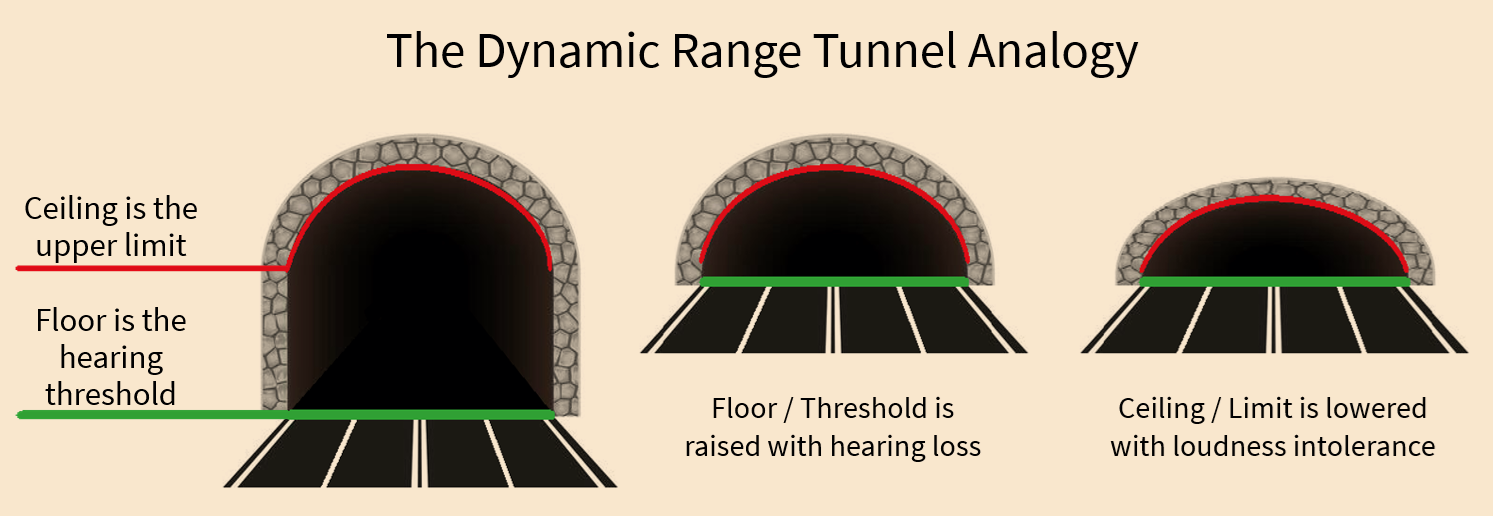
Use multiband compression where significant gain is applied. This is a good place to bring back the tunnel analogy for dynamic range, and respect that folks with hearing loss have reduced hearing real estate available. Experiment with a longer attack and slower release to add clarity and avoid competition of sources. Remember that everyone’s hearing - and hearing loss for that matter - is different, and these settings will need to be explored to optimize the listening experience.
Finish with a peak limiter or multiband limiter to control transients and protect hearing. As with any peak limiting, be careful to avoid aggressive gain reduction as this can negatively impact clarity.
If the results are still unclear, it is advised to reconsider the mix elements and further simplify the sources being presented to the performer.
Because the engineer may hear differently than the performer, trust and communication are essential during this process. It is a rare occurrence that the first settings are the final settings.
Hardware Solutions
There are several purpose-built systems which can aid in this process. Disclosure: while we work with these manufacturers and use their systems, we do not get commission or affiliate payments if you were to make a purchase from the below links.
First, the Sensaphonics 3D Music Enhancement (3DME) system is an active-ambient in-ear monitor system that uses ear-level microphones feeding a digitally controlled analog circuit with zero latency and very high headroom. It is available as a universal-fit or custom system.
The system provides a seven-band EQ and adjustable peak limiter, all accessed by a mobile or tablet app. The user can select if processing is applied to the ambient microphones only or to the full monitor mix. Different settings can be stored and recalled, allowing performers to create multiple variations to address rehearsal spaces and different performance environments.
Importantly, the processing can be adjusted independently for each ear, and the system supports CROS-processing for performers with severe or asymmetric hearing loss.
The popular AVIOM A640 monitor mixer includes a new feature called Audiogram EQ.
This system allows users to enter their diagnostic audiogram thresholds, and the system automatically applies EQ, multiband compression, and additional processing, based on its internal algorithm. The performer can then blend the effect from 0% to 100% depending on preference.
AVIOM also includes a self-test feature that measures hearing thresholds through the performer’s actual monitors or headphones. You can read more about how the system works here.
Less Is More
If, after adjustment and experimentation, you still cannot hear what you need to rehearse and perform, consider reducing elements.
There is a large difference between saying “I can’t hear myself” and “I can only hear everyone else.” It is inherently easier to listen through a simpler mix and a less crowded stage.
Continuing the Process
Once a monitoring solution is established, adjustment and experimentation never truly end. The goal is always to support a musical outcome that remains satisfying for the performer, their collaborators, and their audience.
By taking these steps, musicians with hearing loss can continue performing and the world is not deprived of their music, nor are they deprived of the connection and vibrance it brings.
Work with a Music Audiologist
If you need assistance with this process, consider speaking with a music audiologist. Many of us specialize in collaborating with performers, engineers, and hearing-aid audiologists to translate hearing data into practical monitoring solutions.
Music audiologists can be found through the MusicAud.orgnetwork. We look forward to working together to support you and your music!
Stage Monitoring with Hearing Loss
This article provides practical guidance for performers with hearing loss, as well as supporting knowledgeable audio engineers who are mixing monitors for an artist with hearing loss. For further discussion on the topic, please listen to the Talking Ears episode and Part 2 of this article.
Performing music in front of an audience has to be one of life’s greatest joys. For musicians, it is often also necessary for their living and to express themselves artistically. While stage monitoring is a notoriously difficult technical problem with many confounding factors, one significant barrier which is underdiscussed is the performer’s own hearing loss.
In clinical visits, the question often comes up: How can we sustain an active music performance schedule when your ears don’t hear the way others do, or the way they used to?
Adjusting stage monitoring for hearing loss is a highly individualized process that depends on the musical setting, the specific genre of music, the composition of the ensemble, and of course your specific hearing loss. Each poses different challenges and also opportunities to take advantage of various solutions, which may include:
Audiogram-informed EQ and compression processing
Spatial processing
Ambient miking and talkback systems
Purpose-built monitoring systems such as Sensaphonics’ 3DME and AVIOM’ Audiogram EQ
Instrument-specific pickup and monitoring solutions
The goal with all of these methods is the same: to arrive at a clear and functional mix that delivers what you need to hear to perform.
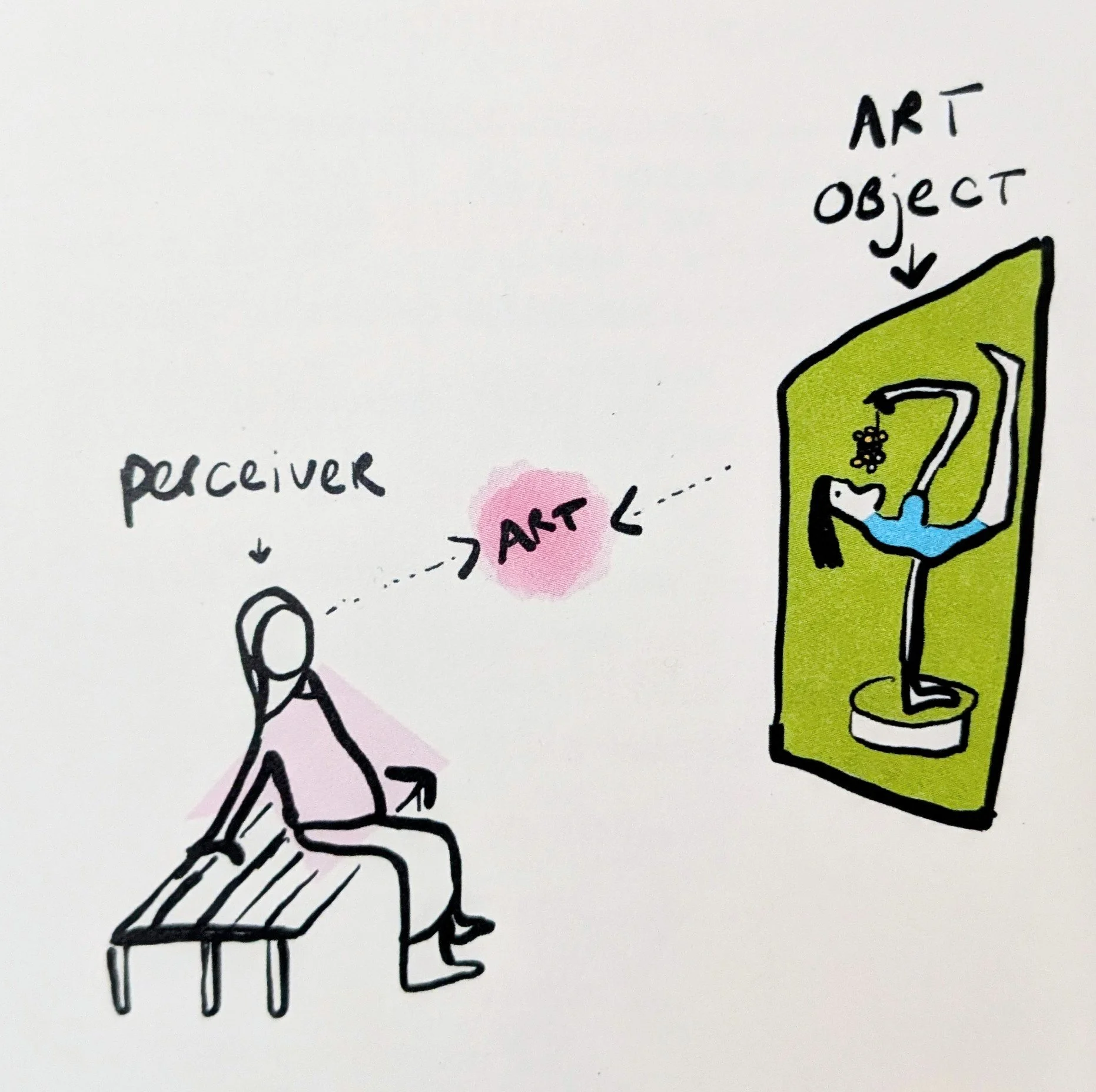
Image credit: Eno, B., & Adriaanse, B. (2025). What art does: An unfinished theory.
This is a good time to mention that our hearing and monitoring also supports connection with the other important people in the room. Of course this includes the ensemble and anyone else who is on stage with you, but less obviously it includes the audience. A performance becomes a glorified rehearsal if we do not consider the audience. Working with musicians - and being performers ourselves - we know that the feedback from the audience is one of the main draws to the stage.
Another important goal is conserving the hearing that you have. Just because you already have hearing loss does not mean it is too late to practice safe listening and hearing-loss prevention techniques. Instead of preventing hearing loss, we shift focus to conserving residual hearing. This becomes increasingly important as hearing loss becomes more severe, since there is less hearing left to conserve and the impact of losing what remains can be profound.
Finally and possibly most importantly, the goal is to arrive at a musically pleasing monitoring solution. When barriers compound, the joy can quickly escape the live performances.
The Floor and the Ceiling of Sensorineural Hearing Loss
Hearing loss comes in several different types, with sensorineural hearing loss being the most common experienced in adults with sound exposure. For this reason, this discussion will focus on sensorineural hearing loss; however, if you or the artist you are working with has a conductive type of hearing loss, there may be a different set of recommendations beyond the scope of this article.
Reduced dynamic range is a hallmark of a sensorineural hearing loss. Dynamic range can be defined as the distance between the quietest audible sound and the loudest tolerated sound.
Analogy Time! You can think of a typical monitor mix like a tunnel that is wide enough to accommodate most, if not all, of the sound sources in a musical setting. The loudest to the quietest - the tallest to the shortest - fit comfortably through the tunnel when one’s dynamic range is in the normal swing of 90 to 120 dB.
Hearing loss, has two major effects on this dynamic range tunnel:
Loss of sensitivity to hearing thresholds. In our analogy, the floor of the tunnel is raised while the ceiling remains where it is. This means the loudest and tallest elements must be squeezed together with the quieter elements just to fit through the newly confined space.
On the other end of the spectrum, loudness intolerance (also known as recruitment or hyperacusis) is also common with most sensorineural hearing losses. These effectively lower the ceiling of the tunnel in the same places where the floor has been raised the most, creating a bottleneck that further complicates monitoring options.
Another barrier is that reliable performance requires control and consistency in environments where stage acoustics and setup can vary widely from venue to venue and night to night. These considerations tend to affect traditional wedge monitors more than in-ear monitors, though both systems have limitations in challenging circumstances.
In an ideal situation there would be a dedicated monitor engineer who understands your hearing loss, knows how to adjust for it in the mix, and is attentive enough to resolve issues that may arise during a performance. If this describes your situation, then share this article with them and reach out if we can support your team further.
Self-mixing, however, requires technical skills to understand the processing involved and access these controls from the stage during rehearsals and performances. Satellite units, standalone monitor mixers, touch screen remote control of wireless mixing boards, and app-based sound controls can reduce this barrier, but they require basic technical skills and - more importantly - a willingness to split attention between performance and technical production tasks.
It’s Not Just About Flipping the Audiogram
The first step in adjusting monitoring to accommodate hearing loss is understanding the audiogram, the term used to describe the hearing test results from diagnostic hearing testing.
Actually, the first step is obtaining an updated audiogram. When you meet with an audiologist, here are several things musicians should ask for based on the Clinical Consensus Document: Audiological Services for Musicians and Music Industry Personnel, published by the American Academy of Audiology (AAA) in January 2020.
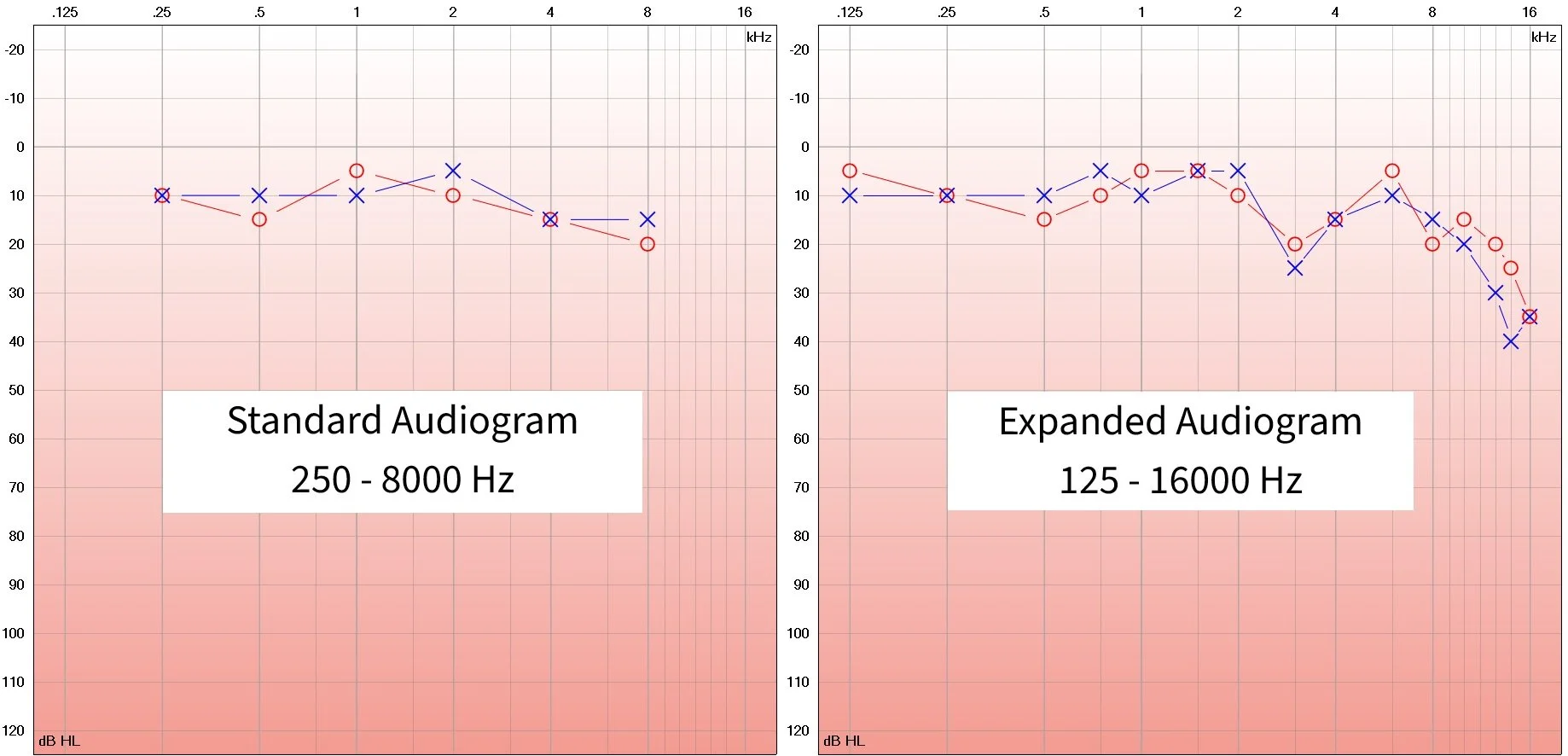
Standard Audiograms test the octaves between 250 - 8000 Hz. Expanded Audiograms, as recommended by the AAA 2020 consensus document, test additional interoctaves and can cover 125 - 16000 Hz.
All available “Interoctaves” Standard audiometric testing is typically performed at octave intervals between 250 and 8000 Hz. In certain circumstances, additional frequencies are added at the half-octaves, including 750, 1500, 3000, and 6000 Hz. These are referred to as interoctaves in audiometric nomenclature. In musical terms they would be considered fifths. The purpose here is to obtain the highest possible resolution for test of a musician’s hearing status.
Extended High Frequencies 8000 Hz is not considered a particularly high frequency in audio engineering terms, but it is the highest frequency tested in standard audiometric exams. Extended high frequencies are available in many audiometers but are not always included in a standard hearing test unless medically indicated or specifically requested. According to the 2020 clinical consensus document, extended high frequency testing up to at least 16,000 Hz is important for musicians and audio engineers who want to understand the upper octave of their hearing.
There is also evidence that this frequency range is more sensitive to damage from sound exposure and may act as an early indicator of hearing injury that does not yet present in the standard audiometric frequencies.
Extended Low Frequency (125 Hz) Most audiometers are capable of testing 125 Hz, a full octave below the lowest standard audiometric frequency of 250 Hz, though it is not routinely tested. For audio engineers, stopping at 250 Hz can feel like being short-changed since that is barely outside the range of low mids. Still, accurate testing below 125 Hz may not be possible in certain clinical settings due to technical limitations of transducers and variability between test environments.
Speech In Noise Testing (QuickSIN) Our ability to parse complex sound settings is based on interplay between what our ears can take in (our hearing sensitivity) and how well our auditory brain can process the signals. Clinical we test this using speech in noise testing, which does exactly what it says on the tin: the patient is instructed to repeat numbers, words, or sentences with progressively more interfering background noise. Musical training tends to improve one’s score in these tests, but significant sensorineural hearing loss can quickly degrade these results.
Uncomfortable Loudness Levels (UCL) Uncomfortable Loudness Levels may help document loudness growth and perceived levels at suprathreshold intensities. Decreased UCLs may indicate decreased loudness tolerance or hyperacusis and may suggest the need for more aggressive compression (more on this shortly) in those ranges. In the authors’ experience, however, these test values are rarely directly translatable into monitoring processing and should be used with caution.
Demystifying the Audiogram
It is important to understand that your audiogram only shows your thresholds of hearing, indicated by a blue X for the left ear and red O for the right ear. These are the softest levels you are able to hear at each test frequency, with a normal range of -10 to 20 dB HL. However, practically all musical monitoring situations occur far above these thresholds. Music performance settings - from solo acoustic rehearsal to a full live band - occur in the range of 70 to 115 dB SPL with very few outliers on either end.
Because of this, the threshold of hearing is only a partial indicator of how to assist someone with hearing loss who wants to monitor music accurately at these higher levels. As discussed, dynamic range often reduces with sensorineural hearing loss so applying one-to-one gain using EQ may “flatten” an individual’s audiometric thresholds, the signal would quickly become harsh, painful, and potential damaging as inputting sounds exceed the quietest audible level.
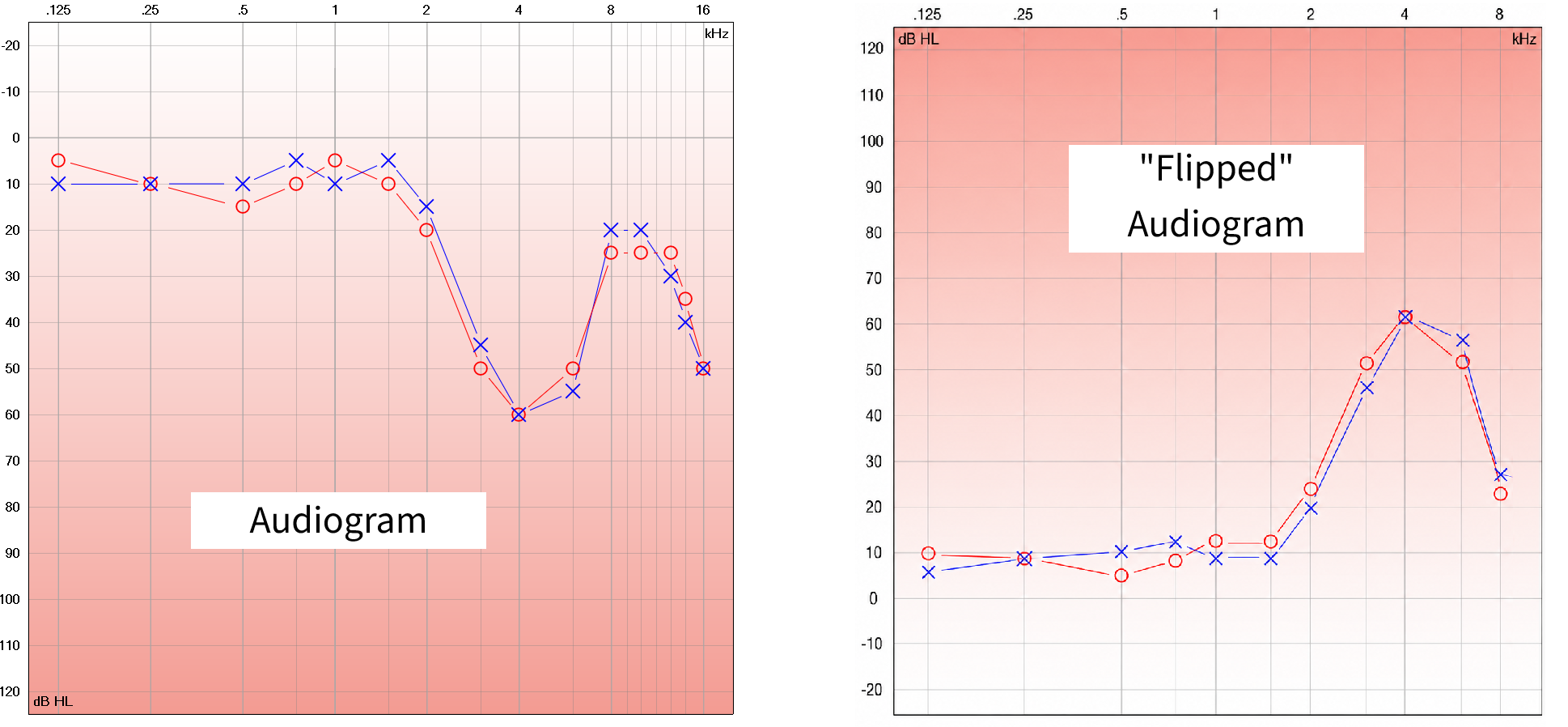
Next, we need to address the upside-down elephant in the room: the audiogram’s Y axis is inverted and displays low intensities at the top and high intensities at the bottom. In this way, a hearing loss is shown as a lowering of the threshold. This is, in a word, confusing. So when we “flip” the audiogram (us the audiometric thresholds to inform EQ and dynamic processing decisions) we are normalizing the orientation to the rest of our audio processing displays.
How Can Hearing Aids Teach Us To Mix Monitors for Performers with Hearing loss??
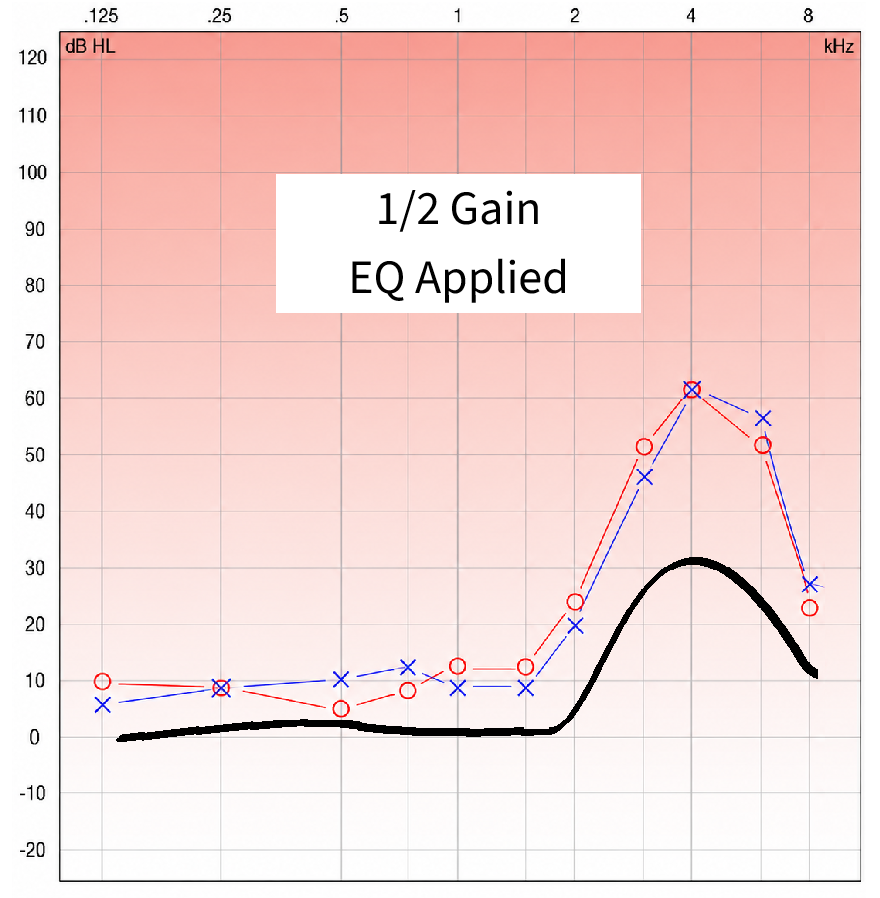
Here we can take some lessons from hearing aid design. Modern hearing aids use complex prescriptive target levels based on decades of research, feedback, and technological advances. While these exceed the scope of this article, we can start with a simple 1/2 or 1/3 gain rule which was historically used as a starting point for amplification fittings.
For example, if a person has a 60 dB hearing threshold, a third-gain rule would apply 20 dB of gain at that frequency, while a half-gain rule would apply 30 dB of gain. The goal was audibility without discomfort.
Modern digital hearing aids instead rely on wide dynamic range compression (WDRC). Compression ratios as low as 1.2:1 or 1.5:1 may be applied across most or all of the signal range.
In other words - and this may make some audio engineers cringe - the compression threshold may be set very low, perhaps at the point of audibility, with the understanding that the compressor will be providing gain reduction nearly continuously. If you find yourself wondering about attack and release times, how the dynamics of music are affected, or how pumping and harmonic distortion are minimized, then you are beginning to understand why music often sounds unsatisfying to musicians through modern hearing aids.
Another reason hearing aids often fall short for music listening is the additional processing designed to improve speech understanding. These systems often include:
Digital noise reduction
Feedback suppression
Speech-focus processing
Adaptive directional microphones
These algorithms attempt to emphasize speech while reducing noise. However, it does not take much imagination to see how this can be counterproductive for musical sources. For instance, an active noise reduction algorithm may hear the sizzle of a jazz drummer’s ride cymbal as unwanted noise and reduce it unnecessarily.
Speech-focus algorithms are actively seeking spoken language and reducing everything else. For instance, the long sustained tone of a flute, woodwind, or operatic singer may be mislabeled as unwanted feedback and the hearing aid may actively suppress them using phase- or pitch-shift algorithms, which can create unpleasant and unmusical effects.
To summarize, traditional hearing aid gain staging is a helpful analogy for mixing monitors for hearing loss, but the advanced processing inherent in modern hearing aids can be counterproductive when the primary source is music.
Solutions: Traditional Mix Management
The primary solution—and something consistent across all options—is traditional mix management. We are taught early on that if something is buried, it is wise to reduce the interference and turn down the overpowering elements instead of turning up the target source. In other words, focus and simplify the mix.
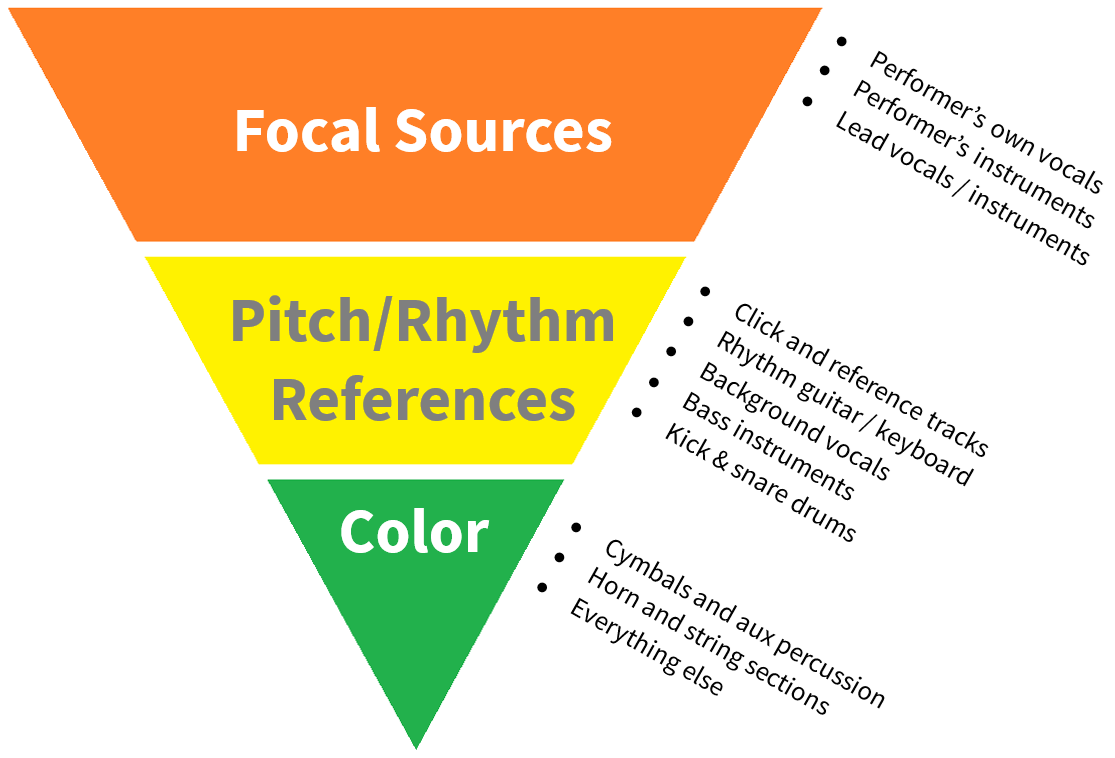
It can be helpful to divide signals into three categories: (1) Focal Sources, such as your own voice and instruments; (2) Rhythm and Pitch References, such as drums, bass, and click track; and (3) Color/Optional Sources, such as horns, strings, and aux percussion. While these color elements add genre-defining favor to the overall musical setting, they are often not mission-critical to a performer’s ability to execute their part. For performers with hearing loss, optional sources can often be muted or significantly reduced.
To Be Continued…
In Part 2 this series, we’ll dive into additional audiogram-informed EQ and dynamics processing, spatial processing, ambient miking, and purpose-built monitoring systems.
If you have any questions before the next section is released, feel free to contact us. Each case is unique and needs individualized attention, and since we’ve seen thousands of cases we can likely help get you on the right track.
Kicking off Season 2 of Talking Ears with a conversation with audiologist and musician Brendan Fitzgerald!
With over a dozen special conversations, taking a moment to think on the importance and the impact of those people’s voices and their music sounds like the most appropriate thing to do. This time, a reflection of someone that we had thought of having a discussion with since the beginning of Talking Ears: Brendan Fitzgerald. A friend, musician, and audiologist, he tapped us into a conversation about his creative methods and the reason why music continues to mean so much to him.

With a strong emphasis on artistic collaboration with the people he gets to make music and embracing experimental rhythmic and harmonic complexity, the music of Brendan Fitzgerald and his bands Wooden Cities and f-f-f-f-Faulty Tower brings forth a realm of acoustic energy that can be described as unpredictable, intriguing, structured chaos, and thought-provoking. Through democratic exploration of both traditional and unconventional means in creating new sound, the tonality and substance of their art challenges the listener to search inward, focus on what the music is doing, brace for the unexpected, and take in a truly awe-inspiring aural experience.
In a seemingly effortless way, Brendan produces a transcendental art form which, (particularly now in an era bursting with trending, capital-driven, and attention-seeking stimulation) pushes what creativity can be and the possibilities of where it can take our minds. All this makes their music one of the most refreshingly original artistic experiences that we’ve had the privilege to encounter.

Talking Ears is beyond honored to present this conversation with Brendan; especially with a new understanding that it’s the people that he gets to play music with that makes the process unique and worth continuing; a feeling that we certainly share.
Stay tuned for the continuation of Season 2 of Talking ears! We have a very exciting batch of episodes coming out in the coming months!
2022 recap and Talking Ears featured in the NHCA "Spectrum" publication
2022 brought about many changes for Earmark Hearing Conservation, including the launch of my music audiology interview podcast, “Talking Ears”. The show provides space for guests to share their stories and views on what is arguably the most important issue in the music industry: hearing health. The formula is rather simple - long-form interviews provide nuance and breadth, while the artist’s own music provides context.

As the host, I try to stay out of the way as much as possible and let the guests’ words and music do the talking. However, this show has marked a significant shift in the way I share my own personal story as an individual who experienced hearing damage and tinnitus due to music exposures from a young age. Though it is a vulnerable feeling and not always comfortable to do so, this relates directly to the philosophy that sparked the show in the first place: dialog and transparency are the bricks that pave the path to better hearing health awareness.

View Article
Click here to download the full NHCA Spectrum article.
One of those instances where I spoke about myself was when past National Hearing Conservation Association president Merlyn Lubiens interviewed me for the recent issue of “Spectrum”, the official NHCA publication. Feel free to read the article through the above link, admire the masterwork writing, and chuckle at the endearing use of a dad-joke to wrap up an otherwise buttoned-up piece. If you listen close, you’ll likely hear me blushing through the pages.

But this isn’t about me. Along with producers Juan Vasquez, AuD, and Mary Kim, AuD, we’ve interviewed Grammy winners, touring musicians, audio engineers, researchers, psychologists, educators, and some of the most renown music audiologists in the world. Their words and music is what we are collecting. And the more personal stories we share, the greater the chance a listener will see their own experiences and attitudes reflected back. The subject remains loosely the same (it is called “Talking Ears” after all) but the views and connections are always refreshing and inspiring to our team.
This is a labor of love, and boy howdy is a labor. From top to tail, each episode takes between 10 to 16 hours for our team to produce. Luckily, the overwhelming response shows that this is a worthwhile endeavor and one we will continue with gusto into the new year.
None of this would be possible without the support of Juan and Mary. The show would be nothing without countless hours spent planning and scheduling guests, listening to interviews, and providing edit suggestions and feedback.
We have incredible things planned in 2023, exciting upcoming announcements, and sincere hopes the future of the show. Your continued listenership means the world to us, and we welcome your thoughts, feedback, criticism, and suggestions. Some would say… we’re all ears.
Best, Frank
Michael Lawrence - talking SPL and concert safety
Michael Lawrence (co-host of the Signal To Noise Podcast), joins us to talk about SPL, loudness, and the audio engineer's responsibility when it comes to exposure risk at live sound events…

Michael Lawrence (co-host of the Signal To Noise Podcast), joins us to talk about SPL, loudness, and the audio engineer's responsibility when it comes to exposure risk at live sound events. Expressed through his work as a system engineer and senior instructor at Rational Acoustics, he brings humanity to the technical aspects and numbers when balancing a concert's perceived loudness and safety of all involved.
This episode features music by Audiologist and Talking Ears producer, Juan Vasquez and his band The Absolute Threshold.
Heather Malyuk - talking fiddle and music audiology
Dr. Heather Malyuk, a fiddle player, lifelong musician, and celebrated music audiology expert, shares her musical upbringing and how she fell in love with her instrument from a young age.
Our special guest this week is Dr. Heather Malyuk, a fiddle player, lifelong musician, and celebrated music audiology expert. She shares her musical upbringing and how she fell in love with her instrument from a young age. As a professional musician herself, she brings realism and empathy to her work as a music audiologist.
"This is one of those things we talk with patients about... wear your hearing protection... [But] sometimes you get to the gig and you can't hear right, and work comes first."

The risk of acquired hearing loss and tinnitus are known and now widely discussed in the music community, but she takes this time to share her personal story of diplacusis - a less common music-induced hearing disorder which results in distorted pitch perception. We also dive into the emotional and physical demands of a musician's life, which can strain one's overall health and wellbeing.
"Everyone hurts, so you think it's supposed to hurt..."
Heather points out that music is a language that provides a unique medium for self-expression, as well as invaluable connection to your fellow musicians. Throughout this episode we'll be hearing music featuring Heather Malyuk to give better context to the relationship between her musical career and her career as a celebrated music audiology expert.
In a special bonus episode of Talking Ears, Heather and Frank will be diving deep into the clinical side of music audiology, so keep tuned for more from Heather! If you would like to book a private virtual appointment with a music audiologist, both Dr. Heather Malyuk and Dr. Frank Wartinger are now on the Tuned platform. Simply follow the below links to view available appointment times, sign up for a consultation, or inquire further. We look forward to caring for you and your ears.
Rickie Mazzotta - talking drums, whiplash, and tinnitus
Rickie Mazzotta joins us to discuss his career as the drummer and founding member of the Philadelphia-based indie rock band mewithoutYou. As the band embarks on their farewell tour after over 20 years making music together, Rickie generously gave his time to check in about the status of his ears, and offer some sage advice to concert goers and young musicians…

Rickie Mazzotta joins us to discuss his career as the drummer and founding member of the Philadelphia-based indie rock band mewithoutYou. As the band embarks on their farewell tour after over 20 years making music together, Rickie generously gave his time to check in about the status of his ears and offer some sage advice to concert goers and young musicians.
Content Warning: this episode contains discussion of mental health and suicide.
Rickie is, by any measure, a loud and energetic drummer, and his approach to the drum set is one of the driving forces behind mewithoutYou’s exciting albums and live shows. In 2019, Rickie experienced what he refers to as “the bomb”. This is when he was first diagnosed with whiplash, which was attributed to his stage movements and the energy he puts into his performances. Did we mention he is an energetic drummer? As it turns out, energy and loudness go hand-in-hand, and his “bomb” was also characterized by onset of debilitating chronic tinnitus, which he described most uniquely:
“Its just like a fairy screaming… a tiny fairy but with this massive weird magical power screaming.”
Coming off tour, he took a full pause on his music career and tried everything to improve his situation and resolve the spiral of tinnitus and anxiety. As it turns out, it was the strategic use of isolating in-ear monitors, awareness of exposure levels, and the careful and intentional return to the stage that did the most good.
Now, Rickie shares his general optimism, and knowledge that he can continue his music career safely while still having the capacity to continue performing with same energy:
“I got a hearing test fairly recently, and its almost line for line the test we did two years ago. So just that alone gives me incredible peace of mind - I can do this thing without further doing more damage to my ears.”
After listening, you can read more of Rickie’s thoughts in our January, 2020 Sound Profiles interview.
Feel free to reach out talkingears@earmarkhc.com to discuss this episode and hearing wellness in general. We look forward to hearing from you. And stay tuned for future episodes, with a hopeful release every couple weeks.
Thanks for listening!
- Frank
Special Thanks
Additionally, I would like to acknowledge everyone who helped with the development of Talking Ears: Scott Hallam, Mary Kim, Juan Vasquez, Brian Heveron-Smith, and Meaghan Strickland - thank you for your time, thoughtful notes, and most of all your patience with me. This wouldn’t be anything without each of you.
Introducing... Talking Ears!
I am excited to announce the start of a new project, a podcast called “Talking Ears”. In this show, I’ll be interviewing music creators about…
I am excited to announce the start of a new project, a podcast called Talking Ears. In this show, I’ll be interviewing music creators about the often overlooked topic of auditory wellness and hearing healthcare for music industry professionals. Through guests’ stories, candid advice, and their own music, I hope to give context to the role their hearing plays in their lives and careers.
With so many musicians developing career-threatening hearing injuries, and sparse training for aspiring musicians and engineers, I feel an urgency to this discussion. The first episode will be released soon, and features in-depth discussion with Rickie Mazzotta, drummer and founding member the band mewithoutYou. In January, 2020, we featured Rickie in a Sound Profile interview, and he was kind enough to check in and give us an update on his ears and life. Now, he is embarking on mewithoutYou’s farewell tour.
Stay tuned!
- Frank
Virtual CAOHC Certification Courses: A Success!
Earmark has been offering CAOHC approved occupational hearing conservation courses for years, but the shift to virtual courses was not an easy one. It has been a success because…
Earmark has been offering CAOHC approved occupational hearing conservation courses for years, but the shift to virtual courses was not an easy one. This change required approval from the CAOHC advisory board, an entirely new course structure, and rigorous development and testing of virtual solutions to replace the keystone section of the in-person certification course: the hands-on practicum. I believe all these changes have made the course stronger and more valuable for students.
Now that we have conducted several successful courses in 2021, and have many more on the schedule, I wanted to take a moment to look at what students are saying about their virtual course experience:
Excellent course and the instructor was great!
I loved the class.
Great course. Thank you for offering virtually!
We have also heard the request for students to have access to written material during the courses. That is why we have made it a priority to ship each student a full CAOHC Hearing Conservation Manual (5th Edition) and official CAOHC Study Guide ($92 value total) ahead of the courses. In addition, we are shipping a generous selection hearing protection devices to each student in order to improve the virtual hands-on learning aspects of the course.
It was a great course w/flexible learning options for its students.
I was not real excited about the virtual course, since I am a hands on person, but it was not as bad as I expected!
Online continuing education is new for all of us, and I want to take a moment to thank each of my past students for their attention and diligence during the courses. For all my future students, I would like to promise you that I will continue to improve and expand the course offerings.
To view the current course schedule and access the registration pages, visit the CAOHC Course information page here.
I look forward to seeing you in the next course!
Sincerely, Frank
(CAOHC Course Director ID #496199)
Rock On…with Caution: Hearing Loss Risk in Musicians
Earmark's Frank Wartinger, AuD, was interviewed for a recent article titled "Rock On…with Caution: Hearing Loss Risk in Musicians" published in the Hearing Journal…

Earmark's Frank Wartinger, AuD, was interviewed for a recent article titled "Rock On…with Caution: Hearing Loss Risk in Musicians" published in the Hearing Journal.
Solid Advice
The article is packed with incredibly honest and sage "I've been there" type advice from industry veterans David Uosikkinen (The Hooters) and Tom Hampton (Marshall Tucker Band, Robert Hazard). Dr. Wartinger's main take-away was simple: never stop making music.
"Yes, there are risks, but with the right tools and precautions, you can reduce your risk. The key is to understand, respect, and protect your hearing as a valuable tool in the music-making process..."
Know better, do better, teach the next generation
Many of rock-and-roll's icons have given their ears to help craft the soundtracks of our youths and good times: Phil Collins, Eric Clapton, Pete Townshend (The Who) and Stephen Stills (Crosby, Stills, Nash and Young) to name a few. In many ways, the technological and stylistic revolutions these visionaries created was the very thing that put them at risk. Bigger audiences and stages, ever more powerful sound systems, and heavier sounds had the cummulative effect of creating a previously unheard-of health hazard: Music Induced Hearing Disorders.
“It is serious business,” said Uosikkinen. “I tell my students that they should take care of their ears because they need to last you an entire lifetime. I'm grateful that technology has made it a little bit better, but I'm still concerned about young people today.
Solutions exist and music audiology experts such as Dr. Wartinger are capable of connecting your performance needs with the long-term needs of your career in music. Reach out to Earmark Hearing Conservation with any questions or comments, or to further discuss your own needs and situation.
Hearing Wellness Workshop Announcement!
On Saturday, October 21st, 2017, Earmark will be hosting a workshop titled "Caring For Your Money-Makers", an event uniquely designed to serve Philadelphia's professional and student music community...
On Saturday, October 21st, 2017, Earmark Hearing Conservation will be hosting a workshop titled "Caring For Your Money-Makers", an event uniquely designed to serve Philadelphia's professional and student music community.
For those who are curious about professional monitoring options, are worried about their hearing health or tinnitus, or want to connect with like-minded musicians, this is the prime opportunity.
What Will I Get?
The two hour event will feature discussion aimed at demystifying your invaluable sense of hearing, practical tips to improve your listening while protecting your hearing, and a chance to demo professional in-ear monitors and hearing protection devices.
Knowing that you should care for your ears is one thing, but respecting how they work and how you can make them work best for you is another.
How Do I Get Involved?
Limited spaces are available, and registration will close on Friday, October 13th.
The ticket price of $60 includes a coupon for free ear mold impression service (up to $85 value) or $60 towards the purchase of any custom device (in-ear monitors, custom earplugs, etc). Basically, the workshop pays for itself and you'll be well on your way to improved monitoring and healthy hearing for years to come.
Sign Up For Hearing Wellness
Contact Earmark to get more information about the workshop and to reserve your ticket.
Special thanks to Aberdeen Audiology for housing the event.
A Music-Lover's Guide to Tinnitus
Frank Wartinger contributed insight and clinically-based commentary to a powerful article written by Angus Finlayson (@angusWFinlayson) for the electronic music publication Resident Advisor. The feature of the article is the powerful accounts of two musician's with tinnitus and how the auditory condition has shaped their lives and...
Frank Wartinger contributed insight and clinically-based commentary to a powerful article written by Angus Finlayson (@angusWFinlayson) for the electronic music publication Resident Advisor. The feature of the article is the accounts of two musician's with tinnitus and how the auditory condition has shaped their lives and careers.

A Music-Lover's Guide To Tinnitus, Resident Advisor.
Words / Angus Finlayson
Published / Thu, 22 Jun 2017
Talking About Tinnitus
By demystifying tinnitus and openly discussing how professional musicians can continue to have a fulfilling relationship with music, this article repeatedly hits on an important message: don't ever stop! Keep going and do so in a manner that respects your ears and hearing.
Act Before You Should Have Acted
The article feedback has been positive and engaging. However, a telling trend has emerged from the comments - those who endorse caution have already been burned.
From those who have not experienced first hand the warning signs of hearing damage, we still hear the chant of "if it's too loud, you're too old". That saying is ironic since both our youth and hearing health are delicate - even transient - and certainly worth appreciating and protecting. Consider that both these things are true: one day it will be too loud AND you will be too old.
I Have Tinnitus... Is It Too Late?
Far from it! If you're noticing constant ringing in your ears or dulled hearing after every rehearsal or gig, these are warning signs that should encourage action. If our feet hurt from running we would given them a rest and look into more supportive footwear. Our ears don't feel pain like that, but with tinnitus and temporary hearing loss, they are able to tell us when something needs out attention.
Reach out to a hearing professional and discuss how you can keep your career on track. Indeed, there are ways of helping even the most dire situations. What's more, musicians often notice improved performances and increased satisfaction when they begin to rehearse and perform with their hearing health in mind.
Hearing Wellness for Musicians
Dr. Frank Wartinger wrote a brief "Patient Handout" document titled "Hearing Wellness for Musicians", published in the April Issue of The Hearing Journal. In the document, he outlined practical solutions to reduce the risk of music-induced hearing disorders (MIHD) in rehearsals and performances...

Hearing Wellness for Musicians
Dr. Frank Wartinger wrote a brief "Patient Handout" document titled "Hearing Wellness for Musicians", published in the April Issue of The Hearing Journal. In the document, he outlined practical solutions to reduce the risk of music-induced hearing disorders (MIHD) in rehearsals and performances.
"By treating our ears as the invaluable, irreplaceable assets they are, we can take important steps to improve our performance while reducing the risk of a career-limiting hearing injury."
Download the PDF for free, or view the article and April issue of the Hearing Journal online.
Of course, as musicians we often find that our settings don't quite fit the mold and some of these suggestions may not apply or require adjustment to work for our needs. Contact Earmark Hearing Conservation to discuss your situation and needs. Phone consultations are free and a good first step towards taking control over your listening and monitoring situation.
Hearing Conservation Through Partnership With Musicians
The Hearing Journal recently published an article by Frank Wartinger, Au.D., titled "Hearing Conservation Through Partnership With Musicians"

Figure. Hearing Conservation, Musicians, Hearing Loss. iStock/cyano66. Source Hearing Conservation Through Partnership With Musicians The Hearing Journal. 70(3):16,18,20, March 2017.
Article on the Musician/Audiologist Interactions
The Hearing Journal recently published an article by Frank Wartinger, Au.D., titled "Hearing Conservation Through Partnership With Musicians"
Clinician's Perspective
The implicit distinction of hearing conservation services for musicians was discussed from the clinician's perspective with the hope of fostering more positive, supportive, and productive partnerships between clinicians and the musicians they serve. By better understanding the musician's goals and needs, audiologists can more effectively discuss performance-oriented aspects of hearing conservation interventions.
Musician's Perspective
In the next issue of The Hearing Journal we will explore the same clinician/client relationship from the musician's perspective. Contact Earmark Hearing Conservation to discuss your past experiences with audiology and how you would like to promote a productive interactions for mutual success.
MusiCares Hearing Clinic in Philadelphia on March 3rd, 2017
Frank Wartinger, Au.D., will be providing earmold impression services for a MusiCares free clinic to qualifying musicians at Philly Sound Studios in South Phila...

Earmold Impression Services
Earmark Hearing Conservation and Frank Wartinger, Au.D. will be providing earmold impression services to musicians at the MusiCares free clinic on March 3rd, 2017. Services will be provided on an appointment only basis at Philly Sound Studios in South Philadelphia.
About MusiCares
MusiCares is the non-profit charitable wing of The Recording Academy and the Grammy Foundation. In addition to providing free dental and hearing services to qualifying musicians, they also provide other forms of assistance to those in need. Contact 212-245-7840 for more information and to request an application for services.
National Hearing Conservation Association position
Frank Wartinger, Au.D., was elected to serve on the National Hearing Conservation Association (NHCA) Executive Council as the Director of Communications...
Director of Communications of the National Hearing Conservation Association (NHCA)

Frank Wartinger, Au.D., was elected to serve as the Director of Communications for the National Hearing Conservation Association (NHCA), and began his 2 year term at the 2017 annual conference in beautiful San Antonio.
The mission of the NHCA is to prevent hearing loss due to noise and other environmental factors in all sectors of society.
Formed by Audiologists and Otolaryngologists concerned with the serious problem of noise-induced hearing impairment, the NHCA now represents engineers, industrial hygenists, safety professionals, nurses and others with interest in preventing hearing damage from occupational exposure to noise.

What Does This Mean For Earmark and Philadelphia's Musician's Clinic?
Good things, for sure. Frank Wartinger is excited to join the NHCA Executive Council in order to gain further expertise to better serve Philadelphia's vibrant music community. He is joining many illustrious hearing conservationists on the Executive Council. As Director of Communications, Frank will be tasked with the dissemination of the most current and relevant information pertaining to the NHCA and the field of Hearing Conservation.
Noise-Induced Hearing Loss - Podcast Episode for Pediatricians
Children’s Hospital of Philadelphia Audiologist Frank Wartinger, AuD, discusses the prevalence, risk factors and prevention strategies for noise-induced hearing loss...

Primary Care Perspectives: Podcast for Pediatricians
Primary Care Perspectives: Podcast for Pediatricians
Episode 6: Noise-Induced Hearing Loss
Published January 2017.
Children’s Hospital of Philadelphia Audiologist Frank Wartinger, AuD, discusses the prevalence, risk factors and prevention strategies for noise-induced hearing loss.
About Primary Care Perspectives: Listen in as Katie Lockwood, MD, a primary care pediatrician at Children’s Hospital of Philadelphia, discusses hot topics in primary care with experts from across the Hospital. In this podcast series for pediatricians, CHOP subject-matter-experts weigh in on issues affecting the daily practice of pediatricians. You can also download these podcasts and subscribe to the series in the iTunes Store.
https://soundcloud.com/childrensphila/primary-care-perspectives-episode-6-noise-induced-hearing-loss
Safety Headphones: Not All Are Made Equal
The Wirecutter just released an analysis of Volume Limiting Earphones, otherwise known as 'Safe' or 'Kids' headphones. Besides confirming that many do in fact protect our children's hearing, it was revealed that many fail to serve up the kind of results we would expect...
The Wirecutter just released an analysis of Volume Limiting Earphones, otherwise known as 'Safe' or 'Kids' headphones. Besides confirming that many do in fact protect our children's hearing, it was revealed that many fail to serve up the kind of results we would expect given their marketing claims. This is concerning and the consumer should be careful to choose a device that has been proven to be safe.
Read more from the New York Times' response here. As always, if you have any questions regarding hearing conservation and safe listening, contact Dr. Frank Wartinger at Earmark Hearing Conservation.
A preventable problem: Noise-induced hearing loss in kids
Philadelphia is hosting the ASHA (American Speech-Language-Hearing Association) Convention this week, and an article on the Healthy Kids section of Philly.com was dedicated to Noise Induced Hearing Loss (NIHL) in children.
Philadelphia is hosting the ASHA (American Speech-Language-Hearing Association) Convention this week, and an article on the Healthy Kids section of Philly.com was dedicated to Noise Induced Hearing Loss (NIHL) in children.
Noise Induced Hearing Loss: A Global Problem
"With a large number of kids using ear buds and headphones, noise-induced hearing loss is a serious issue, according to the American Speech-Language-Hearing Association. Just last year, the World Health Organization estimated 1.1 billion teenagers and young adults are at risk of hearing loss due to the unsafe use of personal audio devices, including smartphones, and exposure to damaging levels of sound at noisy entertainment venues such as nightclubs, bars, and sporting events."

Oran Etkins demonstrating how inner ear hair cells move with sound at an ASHA Listen To Your Buds concert. Image from interview on NBC10, aired 11/15/16
Reaching Children through Music
ASHA has developed and promoted a concert series with the highly successful 'Listen To Your Buds' campaign. With renowned artists such as Oran Etkins and Jazzy Ash & the Leaping Lizards, the message of healthy hearing is being present to children and families in a fun and relatable manner.
How Do We Help Prevent Noise Induced Hearing Loss in children?
"... there are many products available to help parents protect their children’s hearing. These include things like earplugs and earmuffs designed to protect hearing in loud sound environments as well as earphones and headphones that limit the volume levels to reduce the risk for hearing loss. While these products are valuable tools, their appropriate use still requires that the child understands the dangers of loud sound and that they are at risk of noise-induced hearing loss."
Thank you to ASHA and all the amazing guest musicians for bringing this conversation into the limelight in such a creative manner. NBC10 took notice of this topic and featured the discussion on air with an interview featuring musician Oran Etkins and Joy Peterson, Manager of Audiology at the Children's Hospital of Philadelphia.
Earplug Decision 2016
Which earplugs are right for your needs?
Plug'em, an outreach program by the British Tinnitus Association, has a user-friendly guide to hearing protection selection...
Earplugs are like elections (in years other than 2016)
There are many options: foam, silicone, generic, earmuffs, custom fit, filtered, conservative, low-profile, libertarian, Russian-connected, etc...
OK, enough of that.
Which earplugs are right for your needs?

Plug'em, an outreach program by the British Tinnitus Association, has a user-friendly guide to hearing protection selection.
Why British?
Perhaps I'm drawn to them because they are British and sound more intelligent than us yankees, but this site is a well-made resource for hearing protection information. The authors even included a succinct explanation of loudness and hearing risk titled How Loud Is Loud.

Get To Know Your Ear Plug Options
Contact Dr. Wartinger and Earmark Hearing Conservation for a free phone consultation to discuss your unique situation, needs, and options.